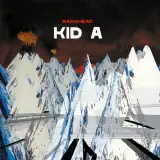
Kid A
Song Meaning
Kid A’s fragmented lyrics and distorted, almost unintelligible vocals reflect Thom Yorke’s discomfort with his own voice and his deliberate attempt to disguise it.
Kid A pairs surreal, fragmented imagery (heads on sticks, ventriloquists, shadows at the end of a bed) with a vocal performance that was deliberately distorted so the singer wouldn’t sound like himself 1. Musically, the track grew out of Jonny Greenwood’s composition, with a bandmate improvising vocal lines over what Jonny was playing 1. The warped, childlike voice isn’t an incidental studio effect: it stems directly from a stated discomfort with hearing one’s own natural voice on the radio 1.
The meaning
Kid A is less a conventional lyric than a mood built from disjointed images: slipping away, a little white lie, heads on sticks, ventriloquists, and a figure standing (or lying) in the shadows at the end of a bed. There’s no linear narrative, and the words function more like fragments surfacing from a dream or a fading memory than a story being told.
What’s verifiable about the song centers on how it was made rather than what it “means” in a literal sense. According to a band member, “the song today was written by Johnny and all I was doing was was talking through what Johnny was playing” 1, suggesting the track originated as Jonny Greenwood’s instrumental idea, with vocals improvised or layered on top in response to the music rather than written first as a lyric sheet.
The most telling piece of evidence concerns the voice itself. The vocal on “Kid A” is heavily processed, pitched and warped into something closer to a ventriloquist’s dummy or a child’s voice than Thom Yorke’s natural singing. A band member explained the reasoning plainly: “I’m not precious about the way my voice sounds at all... I kind of had a problem with my own voice. And hearing people like myself on the radio made me not want to sound like me. And I would do anything, frankly, to not sound like me, but yet still, you know, be able to write and sing” 1. That statement reframes the song’s most disorienting feature, the warped, childlike voice, as a direct response to personal discomfort with one’s own vocal identity, not just a production gimmick.
Read alongside that explanation, the lyrics’ imagery of ventriloquism (“we’ve got heads on sticks / and you’ve got ventriloquists”) takes on a pointed resonance: a voice being thrown, manipulated, or made to come from somewhere other than its source. Whether or not that connection was explicit intent, it lines up closely with the stated desire to sing while sounding like someone, or something, other than oneself 1.
The closing lines, “the rats and the children will follow me out of town,” evoke the Pied Piper, a figure who lures the young away with music, which fits a song titled after a generic, almost anonymous child (“Kid A”) rather than a specific person. Combined with the deliberately dehumanized vocal, the song plays less like a statement about a particular individual and more like an atmosphere of alienation, of a voice stripped of its usual identity and set loose to lead others somewhere uncertain.
Sources
Songs by Radiohead
Last updated 2026-10-01