Enter Sandman
Song Meaning
“Enter Sandman” reimagines the sandman bedtime myth as a story about a child being manipulated by adult warnings, so that a place meant for safety and sleep becomes overrun with fear and nightmares.
“Enter Sandman” is about a child who is told about the mythical sandman by an adult and, rather than being soothed, becomes frightened and unable to sleep. James Hetfield has explained he wanted to capture “the mental thing where this kid gets manipulated by what adults say,” turning a story meant to comfort into one that backfires and terrifies 1. At its core, the song is about the corruption of childhood innocence: a bedroom that should be a place of safety and peace instead gets invaded by nightmares and “things that go bump in the night” 1. The lyrics dramatize this through a child gripping their pillow, sleeping “with one eye open,” and being led off to a “never-never land” that sounds far more sinister than comforting.
The meaning
James Hetfield has said the song grew out of a specific psychological hook: the old idea that when you wake up with grit in your eye, it was put there by the sandman to help you dream. In the song, an adult tells a child this, “and he kinda freaks. He can’t sleep after that and it works the opposite way. Instead of a soothing thing, the table’s turned” 1. That reversal, comfort curdling into fear, is the engine of the whole song.
Hetfield has framed this more broadly as the corruption of innocence. A child’s bedroom “is supposed to be a place of safety and peace,” but in the song that space gets invaded by nightmares, which he calls a kind of violation: “it’s not supposed to happen like that” 1. Lines like “say your prayers, little one” and “I tuck you in, warm within, keep you free from sin” set up exactly that expectation of safety, right before the Sandman arrives and the pre-chorus turns to “sleep with one eye open, gripping your pillow tight.”
The chorus’s “take my hand, we’re off to never-never land” borrows the language of Peter Pan’s Neverland, but strips away its whimsy. Where Neverland is usually a childhood fantasy escape, here it’s repurposed as the Sandman’s destination, a much less pleasant place than the one from the children’s story 1. Verse two reinforces this by swapping out gentle imagery for “dreams of war, dreams of liars, dreams of dragons’ fire,” explicitly noting these aren’t “of Snow White” anymore, innocent fairy tales replaced by genuine dread.
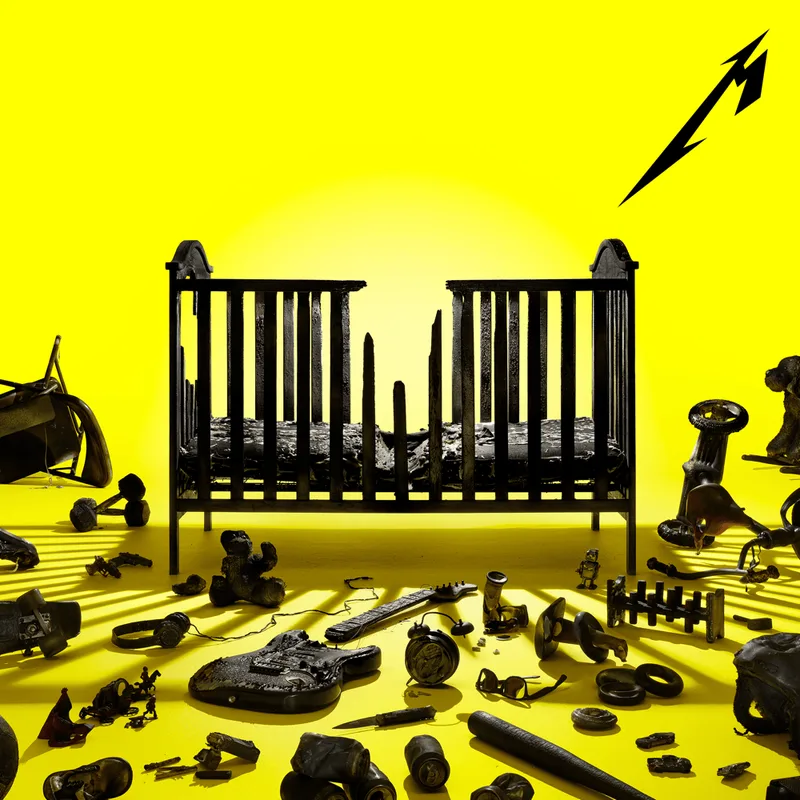
Interestingly, the song didn’t start out this way. Hetfield’s original draft was about a “perfect” family destroyed by a dark secret, built around a lyric referencing crib death, or Sudden Infant Death Syndrome 1 2. He and the band moved away from that literal, grim narrative toward the more universal, mythic version about a child and the sandman that ended up on the record, but the underlying preoccupation with safety being shattered without warning carried over into the finished song.
Beyond Hetfield’s own account, listeners have long read the song simply as being about a child’s fear of nightmares and the dark 1 2, and some fans have layered on their own interpretations, from overcoming fear 1 to religious manipulation 1 to parallels with A Nightmare on Elm Street’s dream-stalking villain 1. These readings aren’t confirmed by the band, but they share the same throughline as Hetfield’s own explanation: something that should protect a child instead becomes the source of their fear.
Sources
Songs by Metallica
Last updated 2026-08-18