Daisy
Song Meaning
“Daisy” by Ashnikko is about a fierce vigilante alter-ego the singer created to punish rapists and abusers, using violent, dominatrix-style power to turn personal insecurity and heartbreak into fearless confidence.
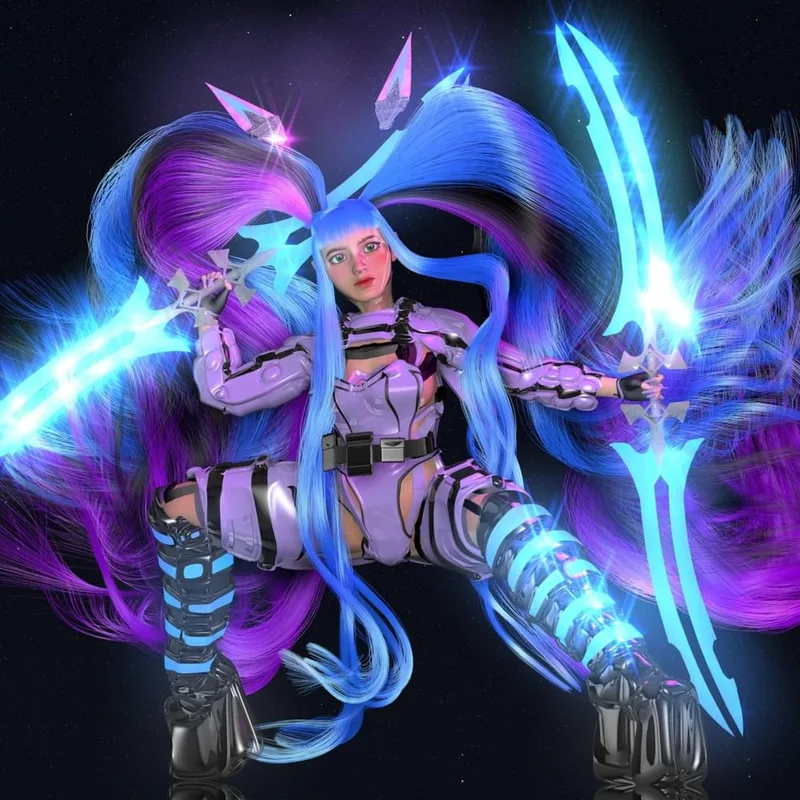
“Daisy” is about a vigilante persona Ashnikko built for the song, a “bad bitch” in latex and glass platforms who “throat punches rapists and other horrible people” 1. Ashnikko has said she created the character while going through a breakup and “really bad insecurity and really low self esteem,” using Daisy to “channel something powerful” 1. The song’s dominatrix energy, gender-neutral “king” imagery, and lines like “call me daddy” express reclaimed control rather than romance 1, while daisies left on a nightstand are described as Daisy’s calling card marking who she’s coming for 1.
The meaning
At its core, “Daisy” is a character study. Ashnikko has explained that she builds a persona around each song she writes and performs, and for this track that persona is Daisy: a “bad bitch who wears exclusively latex, blue diamonds and glass platforms” who “throat punches rapists and other horrible people” 1. The song’s violent imagery, crushed throats, blood “spitting up... in the sink,” isn’t abstract shock value; Ashnikko has said she deliberately wanted that gory image tied to Daisy’s punishment of predators, extending even to a joking image of Daisy going after Donald Trump 1.
The recurring line “Daisies on your nightstand, never forget” functions as a warning marker. Ashnikko describes it literally as “Daisy’s calling card,” left both before and after she confronts someone, so the target knows exactly who came for them 1. Paired with “you don’t wanna get on her bad side... she will crush your throat with her glass platforms,” the song frames Daisy as someone genuinely dangerous to cross 1.
The pre-chorus (“Fuck a princess, I’m a king / Bow down and kiss on my ring”) is about commanding respect rather than romance or gender identity specifically. Ashnikko has said she wants to “be the king, because apparently kings get the most respect,” adding that “a king is not gender specific,” so the royal imagery reads as a claim to authority that sidesteps traditional gendered hierarchy rather than a statement about her own gender 1.
The most sexually charged line, “Make your man call me daddy,” is framed by Ashnikko as a power move with “kind of dominatrix energy,” specifically about making someone else’s partner submit to her without her giving anything back (“he’s not getting none, but he can call me daddy”) 1. She’s also described a companion scene where a target sees Daisy silhouetted in a doorway, finds her intimidating and “crazy,” and is drawn to that danger anyway, reinforcing the song’s mix of menace and magnetism 1. Elsewhere, “no dickstraction can confuse me” reflects Ashnikko’s stated idea that sex can be “distracting” from her goals, positioning Daisy as someone who won’t be derailed by men 1.
Underneath the bravado, Ashnikko has been explicit that Daisy comes from a vulnerable place: the persona grew out of “really bad insecurity,” low self-esteem, and a breakup, built as a way to “need a confidence boost” and “channel something powerful” 1. She’s also compared Daisy to Elastic Girl, someone “adaptable” and able to “roll with the punches,” but who retaliates hard if “taken advantage of” 1. The chorus line “I blossom in the moonlight” captures that arc directly: Ashnikko has said she wanted Daisy to visually read as “blossoming,” “becoming herself,” and turning into a “powerful, vigilante, queen, icon, goddess, king,” even while giving her targets hostile “screw eyes” 1. In that sense, “Daisy” is less a song about a specific relationship and more an origin story for a self-protective, vengeful alter-ego.
Sources
Songs by Ashnikko
Last updated 2026-09-08